

Recent Intelligence: culture, ideas, and obsessions to elevate your week /036
2016 nostalgia, modern intimacy, and the shape of culture now

Your email app may shorten this message. If you see a prompt, just click “view entire message”. For the best reading experience, you can also view it at Hyperreality (the desktop layout is beautiful).


It’s a bright, beautiful winter day in mid-January, and the light lingers a little longer now, each evening stretching itself out like the soft whorls of smoke from the chimneys of the cosy cottages we pass. All week I have been opening boxes sealed for nearly two years, lifting out the small, sedimented layers of a former life, object by object, memory by memory, until the question arises – softly, insistently – of how one begins again, how one furnishes a life once more.
We sold everything, you see – including that wonderfully, dramatically large solid-oak dining table from the old place, the one that anchored whole evenings and doubled as a desk where so much got done. In previous moves, I either clung to everything or let it all go to charity shops in one swift, cleansing gesture. This time we tried something else. eBay. Gumtree. The marketplace of strangers. What surprised me was the speed of it. How quickly the world absorbed what we let go of. Yes, even that beautiful table. The one I may actually have to buy again, because it really was that good.
And you – how are you holding yourself in this moment? Does the freshness of beginning feel light, or does it press with that quiet, unmistakable weight that beginnings so often bring?
This edition of Recent Intelligence includes a life in boxes, sold and unpacked again; winter light on old roads and older cities; the strange ease with which the world absorbs what we let go of; a considered look at 2016 as both aesthetic and emotional reference point; reflections on language and modern intimacy; notable food and wine in Notting Hill; seasonal skincare; and a selection of links to carry you into the weekend.
What follows is a collection of the meaningful and the fleeting: small moments of thought, art, and life.
LAST TIME /at hyperreality

Life Update /009: Yorkshire Edition
On winter roads, old cities, and the slow work of letting go
The last Life Update was in mid-October. This one includes winter travel across Scotland, Leeds, and the Yorkshire moors; oysters eaten standing up beneath the vaulted roof of Kirkgate Market; long walks where the land feels older than memory; the unmistakeable charm of vintage things already softened by use; a near-lost Victorian pub returned to life; and the reckoning that comes with opening boxes you’ve paid to keep for years – objects heavy with former versions of yourself. It’s a letter about movement and return, about gathering and letting go, about what we carry into a new year and what, finally, we might be ready to set down.

MEDIA CONSUMPTION /causes, not blame


Does ‘laziness’ start in the brain?
An exploration of whether what we often label as “laziness” is actually rooted in how the brain evaluates effort and reward. Drawing on neuroscience and real-world observations, this piece challenges moral judgments about motivation and suggests that apathy may arise from subtle differences in brain function rather than character flaws.
Why Doesn’t Anyone Trust the Media?
Several prominent media thinkers examine why public trust in journalism has eroded so sharply. Through a wide-ranging conversation, this piece explores the overlapping pressures of economic collapse, political intimidation, technological disruption, and changing audience habits. Rather than offering a single diagnosis or solution, it traces how these forces interact – and what may be at stake for democratic society if professional journalism continues to weaken – leaving readers to grapple with whether the current upheaval signals decline, transformation, or something in between.
Is It OK to Binge Drink Occasionally?
An examination of whether occasional binge drinking (especially around holidays and celebrations) is as harmless as many people assume. Drawing on expert perspectives, this piece explores how alcohol affects the body and behaviour in both the short and long term, while questioning common beliefs about moderation, tolerance and “special occasion” drinking. Rather than offering simple yes-or-no answers, it invites readers to rethink where the real risks lie and how context, habits and biology all play a role.

RELATIONSHIPS /boyfriend vs partner
Here in the UK, using the word “partner” is extremely common and completely unremarkable. It’s used to describe one’s husband, wife, boyfriend, girlfriend, or someone one lives with long-term, whether married or not. It’s widely used across ages, genders, and relationship types, and it’s also normal in professional or formal contexts such as work, healthcare, or paperwork. So if you hear someone in the UK say “my partner”, it could mean any of the above – and no one finds it odd.
I found it interesting that GQ devoted an entire article to the term after actor Timothée Chalamet, upon winning the Critics Choice Award for Best Actor for his role in Marty Supreme, thanked his “partner of three years” in his acceptance speech. His voice faltered slightly as he said, “Thank you for our foundation. I love you. I couldn’t do this without you. Thank you from the bottom of my heart”.
The author treats the word “partner” not as neutral, but as a loaded cultural signal shaped by politics, generational shifts, and modern relationship anxieties. According to the article, its main function is often to obscure details (such as gender, marital status, or the seriousness of a relationship) allowing for privacy, intrigue, or a subtle display of progressive values. In other words, “partner” is deliberately ambiguous, and its use can communicate as much about the speaker’s social and cultural positioning as it does about the relationship itself.
It's curious how much can be read into a word that, for most of us, is simply read past. In trying to decode what ‘partner’ conceals, perhaps we miss what it offers: the right to be known by what we choose to share, not by what others need to know. ▪︎

TRENDING /2016
Clean typography, warm filters, minimalism mixed with streetwear, tumblr-era softness crossing into Instagram polish. People don’t miss 2016 because it was perfect1. They miss it because it was lighter and less surveilled. In retrospect, 2016 feels like the last year before culture hardened. Before every post became a performance, before every opinion felt like a stance, before the internet learned how to monetise anxiety. Life online still had softness then: warm filters, candid moments, jokes that didn’t need disclaimers.
Instagram was not yet a marketplace of selves. It was not about reach or optimisation; it was about mood. Clarendon made an ordinary afternoon feel consequential. Sunsets appeared without irony, without self-consciousness. You posted because you wanted to remember, not because you wanted to be remembered. People were not brands. They were people, assembling small records of their days. It felt, somehow, shared.
The internet felt social in the literal sense. Memes spread because they were funny, not because they were optimised. Vine was chaotic, creative, and short-lived in the best way. Virality felt accidental. You laughed with strangers, not at them. Logging on felt like entering a shared room instead of stepping onto a stage.
Pop culture followed the same logic. Albums arrived as events – Drake, Rihanna, Frank Ocean, Kanye – and were absorbed collectively. Songs attached themselves to summers, to car rides, to friendships, becoming markers of time rather than content units. Experience still preceded documentation.
There was also a certain optimism underneath it all. The future felt open. Technology still promised connection more than extraction. You could imagine a better version of yourself without feeling chased by metrics or haunted by constant bad news. Even when the world felt messy, it didn’t feel inescapable.
What people are really nostalgic for isn’t the year itself, but the emotional temperature of that time. News existed, but it didn’t follow you everywhere. Group chats were for jokes, not the shared processing of disaster. You could log off without guilt, and log back on without dread.
In retrospect, it reads as the last year before everything was counted. Before every moment required evidence. Before irony became a form of self-protection. Clarendon did not simply warm images; it softened experience. And maybe that’s what we miss most: a time when being online felt less like survival and more like living. ▪︎


2016 / where i was
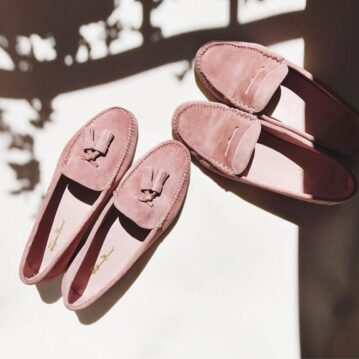
In 2016, we were living in Spain. The days moved differently there – slower, warmer, shaped by light instead of deadlines. We ran Belgrave Crescent then, along with Shop TIG, a careful curation of things made by hand: wicker woven by artisans just outside the city, jewellery I designed and a third-generation jeweller brought to life, pink suede loafers crafted in the south that somehow became the thing everyone wanted.
The work felt intimate in a way it doesn’t anymore. We knew the makers, visited their workshops. Business was personal, built on conversations over coffee and trust that grew slowly. There was no optimisation, no algorithm deciding what deserved attention. Just objects we believed in, made by people we respected, offered to an audience that felt more like a community.
Our days were drenched in sun and Spanish architecture – ornate balconies, tiled courtyards, buildings that had stood for centuries and would stand for centuries more. Time felt abundant. We made new friends, new collaborators, new versions of ourselves. The city taught us how to live: long lunches, late dinners, the understanding that beauty and work were not separate pursuits but woven together.
Looking back, it feels like we were building something that still had room to breathe. Before commerce required constant presence, before every post needed a strategy, before rest felt like falling behind. We were simply there, making things, living fully in a place that let us be both ambitious and unhurried. It was work, yes – but it was also just life, unfolding in real time. ▪︎
MEDIA CONSUMPTION /artificial intelligence


What AI doesn’t know: we could be creating a global ‘knowledge collapse’
As generative AI becomes a dominant gateway to information, it risks accelerating a global “knowledge collapse” by entrenching long-standing power imbalances in whose knowledge is seen, valued and preserved. Drawing on personal experience, Indigenous practices, and examples from language, ecology, architecture and water management in India, the author shows how AI systems trained mainly on English-language, western, written sources systematically marginalise oral traditions, local expertise and “low-resource” languages. Because large language models amplify statistically dominant ideas and are shaped by commercial, institutional and legal incentives, they not only reflect existing hierarchies but intensify them through feedback loops that narrow what humans can easily access or even imagine. The result is not just a loss of cultural representation but a dangerous erosion of diverse, place-based knowledge essential for ecological resilience and human survival – suggesting that without rethinking what counts as knowledge, AI may deepen crises rather than solve them.
Our AI, Ourselves?
A look at how recent novels are responding to the rise of artificial intelligence, not by predicting distant futures, but by reflecting our present uncertainty about consciousness, language and what makes us human. Through a discussion of contemporary fiction, this article suggests that AI has become a mirror for human habits, anxieties and moral blind spots, especially around surveillance, conformity and interior life. Rather than offering clear answers, the piece invites readers to consider why literature remains uniquely suited to exploring human thought and experience at a moment when machines increasingly imitate them.
WINTER /skincare

If you've been reading for a while, you'll know I'm always looking for a sunscreen that actually works. Most are too thick, chalky, or leave a white cast. I've been using this one for a while, though it can be a bit runny and gritty. The Supreme Screen SPF 50 has a much better texture – it blends in completely and sits well under makeup. Their Luminising Skinscreen is nice too, and the mist format makes it easy to reapply throughout the day.
Australian skincare seems to be having a moment right now, largely because brands there tend to take sun protection seriously. Many also use native ingredients like Kakadu plum and put real thought into formulation and sustainability, which has helped some smaller labels gain wider attention.

THE BARBARY /notting hill

The Barbary’s Notting Hill outpost, which opened in September 2024 on Westbourne Grove, marks a significant expansion of Zoë and Layo Paskin’s much-loved Neal’s Yard original. Set within a Grade II-listed corner building, the restaurant is conceived as a flagship: larger, more expressive, and more versatile than its Covent Garden predecessor. With roughly 75 covers, an open kitchen counter, booths, and a dedicated cocktail bar, it preserves the core Barbary ethos – fire-led cooking inspired by the cuisines of the Barbary Coast, from southern Spain to North Africa – while broadening its scope. The menu, overseen by head chef Daniel Alt with group development chef Aika Levins, features familiar signatures such as merguez, flatbreads, and basbousa alongside new dishes that lean further into Southern European influence.


The wine list is a defining feature of the Notting Hill site, with around 250 bottles spanning both classic and emerging regions. It places a strong emphasis on sustainably produced wines, alongside rare and prestigious reserve bottles, including labels such as Krug, Salon, Latour, Petrus and Y’Quem. A dedicated cocktail bar further expands the drinks offering.
Designed by Archer Humphryes Studio, the interior layers natural materials, warm textures, and generous light, positioning The Barbary Notting Hill not simply as a second site, but as a fully realised evolution of one of London’s defining modern restaurants.
LAST LOOK /a few quick links for the weekend
The Benefits Of Taking Fish Oil Supplements, Explained
These jeans are nice (and they’re currently on sale)
Where to ski in Norway: an ultimate guide to Europe’s underrated slopes
If you’ve been considering a Cashmere Lounge Jumpsuit for these winter days, now is the time.
What Happens to Your Body When You Take Turmeric Regularly
Happy New Year
bisous & that’s all for now…

PARTING NOTE
Your engagement (likes, shares, recommendations) creates the kind of community that makes this work possible. It's how ideas find new readers and conversations deepen. Thank you for being part of this. 🖤
RECENTLY at Hyperreality


Thank you for believing that depth requires time, that the best ideas emerge only when we refuse to hurry them along.
Far from perfect, 2016 was also a year of rupture. Beneath the warm filters and casual afternoons, the world felt suddenly sharper, more urgent. Politics moved from the margins into daily life: Brexit, the U.S. presidential election, and the rise of viral outrage made distant events intimate, personal, and impossible to ignore. The phrase “post-truth” gained traction, capturing a world where emotion often outweighed facts. Social media, once playful, became exhausting – algorithms amplified extremes, humour grew ironic and defensive, and online quarrels left no corner untouched. Yet even as anxiety spread, conversations about race, gender, sexuality, and representation gained force, creating progress alongside tension, hope alongside friction. As the present felt increasingly unstable, nostalgia surged. Reboots, remakes, vinyl records, retro aesthetics, and '90s revivals flourished. Looking backward became a way to feel grounded when the future felt uncertain – much like now. And the year kept taking from us: David Bowie, Prince, Leonard Cohen, Carrie Fisher, George Michael, Sonia Rykiel, Muhammad Ali, Harper Lee, Alan Rickman, Gene Wilder. Loss accumulated quietly, like a closing door. It was not the end of innocence, exactly – but it was the moment we felt something ending, even as we kept posting through it.
A quick note on "partner" as an American - ime it is more commonly used for business relationships. My husband introduces his business partner as "my partner." I sometimes hear people refer to their boyfriends/girlfriends/spouses that way, but I usually have to look for context clues that they're referring to a romantic relationship. Or, if they're using the word "partner" they'll add a qualifying like "my life partner" or "my girlfriend and partner." No judgment to Timmy about his word choice, just wanted to comment on the apparent cultural difference!
This captures something essential about why certain years feel suspended in memory. The observation about 2016 being 'lighter and less surveilled' really nails it. I've noticed the same shift from accidental virality to optimised content, where every post needs strategy now. Back then posting felt like conversation, now its performance. What gets me most is the point about experience preceding documentation, that use to be the default and now its almost impossible to find.